
Ottawa County Probate Court Venue
Ottawa County probate matters are handled through the District Court, not through a separate probate court building or independently elected probate judge. The local court counter is the Ottawa County District Court at 307 N. Concord, Minneapolis, KS 67467. The researched phone number is 785-392-2917, and the District Court administration page identifies Clerk of the District Court Erin Kearn at erin.kearn@kscourts.gov. Court hours are Monday through Friday, 8:00 a.m. to 5:00 p.m., closed noon to 1:00 p.m.
The Ottawa County probate record path includes online public case search where available, in-person access at the District Court counter, phone questions, mail requests to the court address, and certified copies through the District Court clerk. If an older estate file is not in Kansas Case Search, use the court counter or phone channel because the official county site does not publish a separate probate index.
That local fallback matters for estate research. Probate files may span many years, include later accountings or reports, and contain orders entered after the first petition. A search result may not show every paper needed for title work, fiduciary proof, or family-history research, so certified copies and file completeness should be confirmed with the clerk.
The assigned image from K.S.A. 59-103 probate jurisdiction is included because Kansas probate authority defines the kinds of matters the District Court can handle.
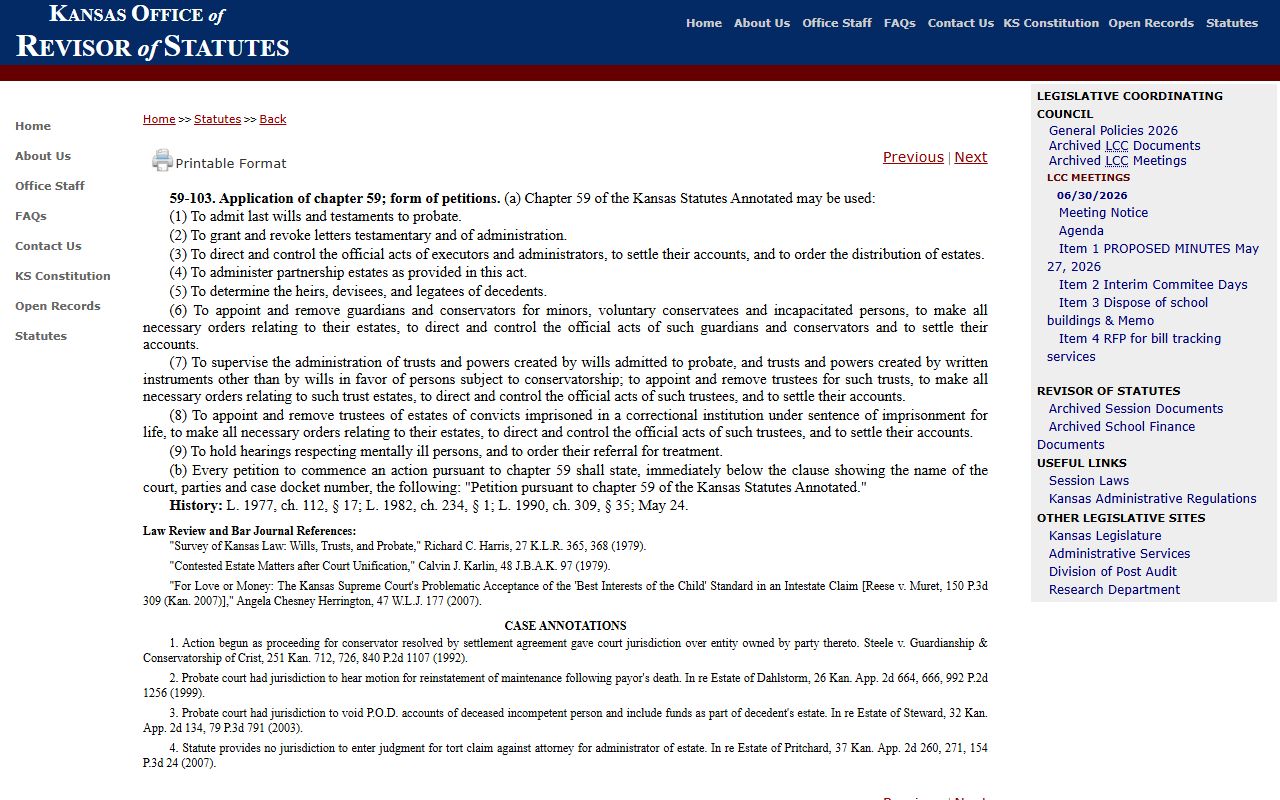
This jurisdiction source supports the Ottawa County Probate Division content because the county's probate work is part of the Kansas District Court system.
Ottawa County Probate Contact
Use the District Court clerk for probate filing fees, copy requests, certified probate records, hearing questions, and local access issues. Probate filings can involve legal choices, deadlines, notice duties, fiduciary obligations, and restricted information. Court staff can route records and filing questions, but legal advice should come from an attorney.
For guardianship, conservatorship, mental health, or care-and-treatment material, ask the clerk what portion of the file is public before assuming a full file can be inspected. Kansas probate jurisdiction is broad, but public access can narrow when protected adults, minors, medical facts, or sealed reports are involved.
Probate Division of the District Court
Ottawa County District Court
307 N. Concord
Minneapolis, KS 67467
785-392-2917
Clerk: Erin Kearn, erin.kearn@kscourts.gov
Monday-Friday, 8:00 a.m.-5:00 p.m.; closed noon-1:00 p.m.
Ottawa County Probate Terms
Probate records use terms that are easy to confuse. The definitions below are short working definitions for reading an Ottawa County probate file. The exact legal effect depends on the order, filing, and Kansas law involved in the specific case.
- Probate
- Court process for estates, wills, guardianships, conservatorships, trusts, and related supervised matters.
- Decedent
- The person who died and whose estate may need court administration.
- Will
- A document that states how a person's property should pass after death.
- Letters testamentary or administration
- Court authority allowing a fiduciary to act for an estate.
- Determination of descent
- A probate filing used to determine heirs or ownership succession in the proper case.
- Guardianship
- Court supervision of personal care decisions for a person who needs a guardian.
- Conservatorship
- Court supervision of property or finances for someone unable to manage them.
Search Ottawa County Probate Records
Kansas Case Search is the online starting point for public District Court probate records where available. Because the research could not inspect a sample Ottawa County probate file and no local sample probate docket is published, the safest search process keeps online lookup and clerk verification together. Public access may be limited for guardianship, mental health, social or medical reports, sealed materials, and other restricted portions.
- Search Kansas Case Search for public District Court probate records by the available party, case, or estate information.
- If the record is not online, call Ottawa County District Court at 785-392-2917 or visit the counter at 307 N. Concord.
- Ask whether the file is public, partly restricted, older, sealed, or available only by clerk request.
- For certified copies, request certification through the Clerk of the District Court rather than printing an online result.
- For forms, check Kansas Judicial Council probate materials, then confirm local filing needs with the court or counsel.
Note: Kansas public-record access does not make every probate document public, especially reports tied to care, treatment, minors, or protected adults.
Ottawa County Probate Fees
Ottawa County's District Court filing-fee page lists three probate-related docket fees. These amounts are local court filing fees, not attorney fees, publication costs, certified copy fees, bond premiums, or other case expenses. Confirm current totals with the clerk before filing because a specific case may require more than the base docket fee.
| Probate Filing Item | Amount |
|---|---|
| Probate Estates | $131.50 |
| Probate, Property - Determination of Descent | $71.50 |
| Probate, Trust, etc. | $91.50 |
Ottawa County Probate File Contents
Common Ottawa County probate records may include wills and codicils, petitions to probate a will, petitions for administration, letters testamentary or letters of administration, determination of descent filings, estate inventories, creditor notices, claims or allowance of demand, orders approving sales or distribution, final accountings, guardianship and conservatorship petitions or reports, trust-related pleadings, and care and treatment filings where applicable.
No sample Ottawa County probate file was inspectable in official sources because Kansas Case Search was blocked during research and no local sample docket is published. Expected fields to verify later include case number, estate or decedent name, filing date, petitioner, attorney, fiduciary, judge, event list, hearing dates, bond, letters issued, inventory or accounting due dates, orders, claims, and final settlement or distribution.
| Field | What It May Show |
|---|---|
| Case number | The court's identifier for the probate matter. |
| Estate or decedent name | The estate or person tied to the probate filing. |
| Petitioner or fiduciary | The person asking for court action or appointed to act for the estate. |
| Event list | Chronological filings, notices, hearings, and orders. |
| Letters issued | Authority granted to a personal representative, executor, or administrator. |
| Inventory/accounting due dates | Deadlines tied to estate or guardianship reporting duties. |
| Orders and final distribution | Court decisions approving action, settlement, or closure. |
Ottawa County Probate Process
The basic Kansas probate path depends on the estate and the type of filing. Some estates may use a small-estate affidavit or nonprobate transfer instead of a full estate case. Other matters require petitions, notice, hearings, fiduciary appointments, inventories, claims, accountings, and court approval. Ottawa County filings should be made in the District Court when Ottawa County is the proper venue.
- Identify whether probate is needed or whether a small-estate affidavit or nonprobate transfer may apply.
- File the correct petition or form in Ottawa County District Court if Ottawa County is the proper venue.
- Pay the local docket fee for the estate, determination of descent, trust, or other probate matter.
- Give required notice or hearing notice under Kansas procedure.
- Obtain court orders or letters if the filing is approved.
- Gather estate property, address claims and expenses, file required inventories, accountings, or reports, and seek final distribution or closure.
- For guardianships and conservatorships, expect ongoing reporting and supervision under court rules.
Ottawa County Probate Forms Rules
Kansas Supreme Court Rule 109 covers supervision and reporting in probate cases. The researched rule summary states that an annual report or accounting is due no later than 30 days after the end of the reporting period. That rule is important for guardianship, conservatorship, and other supervised probate matters where the case does not end with a single estate order.
The assigned image from Kansas Supreme Court Rule 109 is included because it relates to supervised probate reporting duties.
Rule 109 helps explain why some Ottawa County probate files can include ongoing reports, accountings, and court supervision after the first filing.
The Kansas Judicial Council probate forms page and small-estates affidavit page were failed manifest rows with blank filenames, so no images are added for those sources. The researched content still identifies useful form sources: K.S.A. 59-2210 Probate Hearing Notice, Petition for Allowance of Demand, the Small Estates Affidavit, and Kansas Judicial Council Probate Forms 3d materials. The Judicial Council warns users to seek attorney advice if questions remain after reading instructions, and fillable PDF features may require downloading the file and opening it in Adobe Reader.
Restricted Ottawa County Probate Records
Probate is generally a court-record category, but not every probate-related document is public. Guardianship records, conservatorship reports, mental health or care-and-treatment records, social or medical reports, adoption-related material, sealed filings, and protected identifying information may be restricted. Kansas Supreme Court Rule 24 protects personally identifiable information in public electronic court records, and Kansas public-record exceptions may require closed information to be separated from open material.
For Ottawa County probate access, this means an online result may show a case shell or event history while withholding documents or details. A clerk may also provide public portions while denying or redacting restricted portions. If the record is needed for a legal proceeding, estate administration, title issue, or financial institution, ask the Clerk of the District Court whether a certified copy is available and whether any court order is required.